As a Director, Executive, or Manager of a company, you have an obligation to manage the day-to-day operations of the organisation, its people, and its resources. Leadership accountability in Australian business plays a critical role in the effectiveness with which those responsibilities are carried out and in the consistency with which results are achieved.
Each year, you may reflect on how you would like things to be, making sure you meet your obligations to the company while still ensuring you have quality time for yourself and your family.
For the first few weeks, you may be able to implement these changes, but somewhere along the line, you find yourself slipping back into old patterns.
• Staying back at work when you have promised the kids that you would be home on time.
• Doing more of the workload than you anticipated because you can’t seem to get your team to do it, or it’s not to your standards
• Finding that you feel withdrawn from work and are no longer feeling that same drive.
But what if you could change this? What if stronger leadership accountability allowed you to work fewer hours and still increase the profits and performance of the company consistently every month?
For some, that may sound impossible. But what if it were possible? What if it could be a win-win for everyone, the company, your staff, you and your family?
Why Leadership in Accountability in Australian Business Matters
Sustainable change does not happen by accident. It starts with clear expectations, disciplined planning and consistent leadership behaviours that set the tone for the entire organisation.
Here are 5 strategies to get you started:
1. Set the intention
How do you want your day to play out, and what does it need to include? Plan your day so that the most urgent tasks are completed in the first half of the day. Often, your day becomes chaotic when unexpected issues arise, and that is when pressure starts to build. Much of this can be minimised with planning and by allowing time for the unexpected. Strong leadership accountability begins with taking ownership of how you structure your time.
2. Block out time
Do not let things drag on longer than they need to. For example, when setting meetings, make sure there is an agenda communicated to all attendees, and be disciplined about sticking to both the agenda and the scheduled time.
Have you ever been in a situation where a meeting runs over time, and you spend the rest of the day trying to catch up? In some cases, that is what leads to staying back late at work. Effective leadership requires boundaries that protect both productivity and performance.
3. Attitude/Mindset
Think about the current mindset you have around challenges. If the first thought that pops up in your mind does not support your intention for the day, then you need to change it.
4. Set some rules
Have some general rules that you instil into your day-to-day activities at work. For example, do not schedule meetings at 4.30 pm if work hours finish at 5.00 pm. People are less likely to be attentive at that time of day because they are focused on leaving work on time
Another example is setting up a meeting with yourself, yes, yourself, for the first half hour of the day so you can get a few things done without disruption. Something that would normally take you an hour can often be completed in half an hour when you are fully focused.
5. Challenge the status quo
How many times have you heard people say, “But that is how we have always done things around here”? What if you did things differently, or perhaps did not do them at all?
For example, imagine sending out a monthly report that takes one full day to complete. What if you stopped sending it and waited to see whether anyone noticed or asked for it?
If they do ask for it, question what they actually use it for. If they only need one piece of information from it, perhaps that could be sent in a simple email that takes five minutes, rather than losing an entire day. Strong leadership means questioning inefficiencies and making decisions that improve performance.
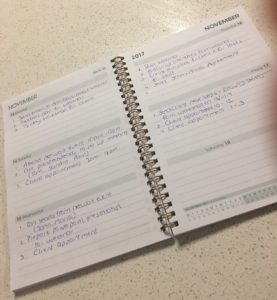
Tomorrow make sure to have your intention already mapped out. Take fifteen minutes at the end of today and write these down. Start with the top three activities, allocate time to each activity and make sure to schedule them in your calendar.
Tomorrow, make sure your intention is already mapped out. Take fifteen minutes at the end of today to write it down. Start with the top three activities, allocate time to each one, and schedule them in your calendar.
Remember to challenge the status quo and be aware of your daily thoughts, asking yourself whether they support the needs of the company, its stakeholders, your staff, your family and you.
EmpowerBeyond – Business Performance Solutions, focusing on people, process, products and services, and improving productivity and cash flow.



 people you are going to call.